How would you feel if you lost $10,000 in a month on Google ads that never turned into a single booked job?
This is the reality for many home service owners who treat their marketing budgets like slot machines. It is painful to watch your hard-earned revenue vanish into the void of the internet without a return.
This guide breaks down where LSAs win, where Search Ads do well, and how to choose based on lead quality, cost control, speed, and scale. You will understand the core differences between the two biggest lead sources on the web today.
Google LSAs vs. Google Search Ads | ||
|---|---|---|
Factors | Google LSAs | Google Search Ads |
Best for | Immediate local leads & Emergency calls | Precision targeting & brand scaling |
How you pay | Per lead | Per click |
Lead Intent | Variable | Variable |
Speed to Lead | Instant call or message | Click → Website → Form/Call |
Trust | Google Verified badge + reviews | Relies on ad copy and website |
Control | Limited (Google handles matching) | High (You choose every keyword & bid) |
Scalability | Capped by local search volume | Virtually unlimited |
Geo-Targeting | Forced proximity (Near your location) | Flexible across any ZIP or city |
Demographics | No control | Target by Age, Income, Gender, etc. |
Remarketing | None (One-and-done interaction) | Full (Follow visitors around the web) |
Landing Page | Standardized Google Profile | Custom, high-converting landing pages |
Voice Search | Primary result for “Near Me” voice tasks | Included in AI/Conversational results |
Revenue Tracking | Basic (Status: Booked/Sold) | Deep (Full funnel ROI & LTV tracking) |
The Trust Gap: Google LSAs vs. Search Ads
When a homeowner needs an inspector or a plumber, they are usually in a state of mild panic or high stress.
In such a scenario, the “Google Verified” is the trusted advantage you have. This little blue checkmark tells the customer that Google has already done the homework for them.
They know you are insured, licensed, and have passed a background check before you even pick up the phone.
A standard search ad simply cannot offer that same level of instant, verified credibility.
The Federal Trade Commission has been cracking down on fake reviews and deceptive advertising for years. As a result, consumers are becoming increasingly skeptical of traditional paid ads.
This is a major reason the conversion rate for LSAs often remains higher than that of traditional search traffic.
Why Google Local Service Ads Work So Well
One of the biggest advantages of LSAs is that you stop paying for attention and start paying for actual conversations.
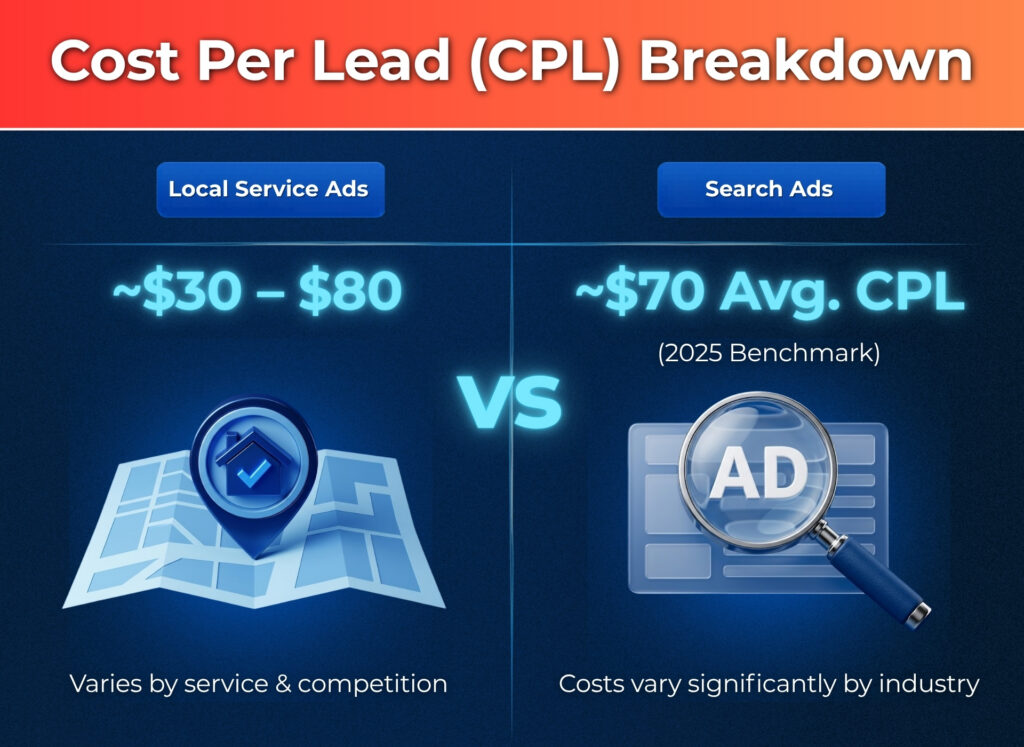
That means less wasted spend on “window shoppers” and more budget going toward actual opportunities. Have a look at some of the key benefits of LSAs:
- Pay for leads, not clicks
You’re charged only when someone reaches out, not when they casually click.
- Lower wasted ad spend
Filters out low-intent users who are just researching or price-checking.
- Built-in trust signals
Google-backed verification and reviews instantly increase credibility.
- Performance-based visibility
Faster response times = better rankings in local results.
- Less technical optimization required
No need to constantly tweak headlines, keywords, or landing pages.
The system favors businesses that actually answer calls and deliver good service, not just those with better ad copy.
where Search Ads Give You More Control and Precision
While LSAs are great for trust and speed, Search Ads are where you get real control over who you target and how you convert them.
Instead of relying on Google’s system to match you with leads, you decide exactly which keywords to target, which services to promote, and how your message is presented.
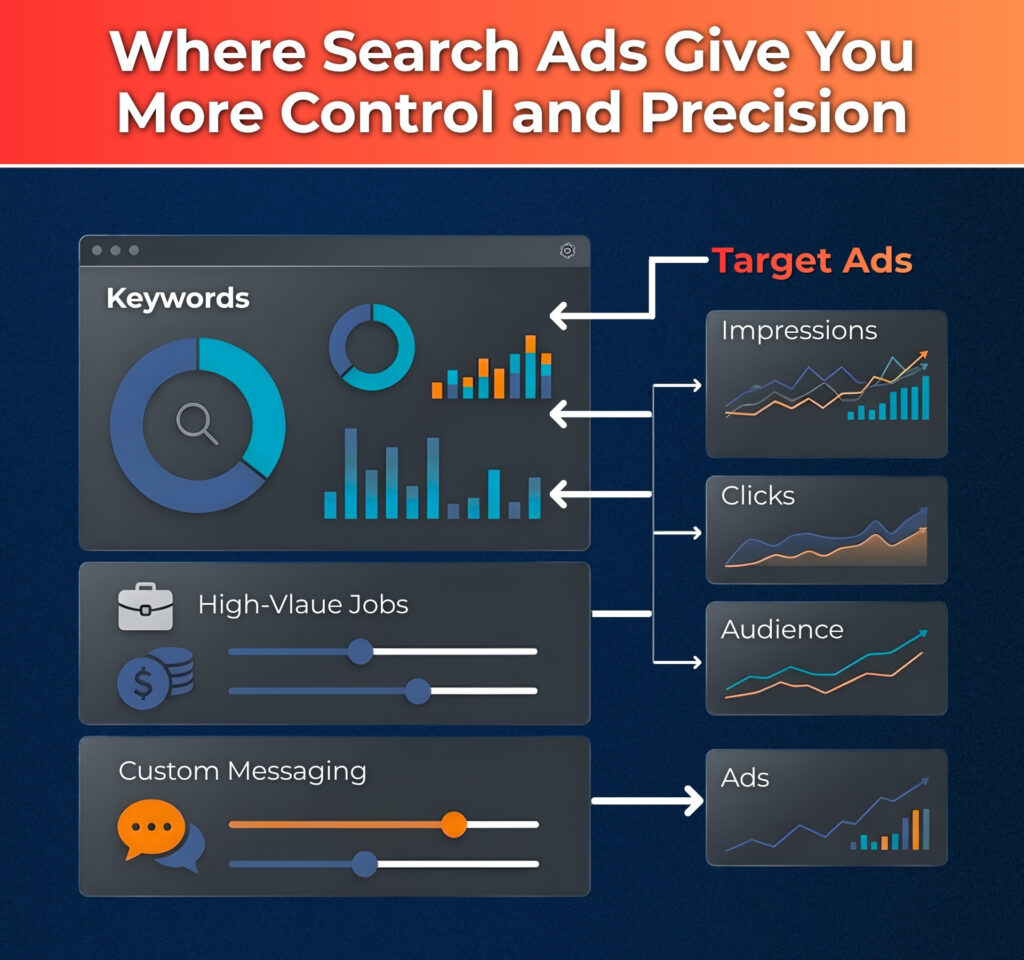
Here’s where Search Ads really stand out:
Precision targeting with keywords
You can target highly specific, high-intent searches instead of broad service categories.
Control over high-value jobs
Create campaigns focused on profitable services (e.g., commercial inspections vs. basic ones).
Custom messaging for each audience
Tailor your ad copy to match exactly what the user is searching for.
Stronger brand differentiation
Showcase your expertise, process, and unique value instead of blending in with competitors.
More control over lead quality
Use your website content to filter out low-intent prospects before they contact you.
With Search Ads, success isn’t about visibility alone. It’s about how well you guide the customer from click to conversion.
How Big Can You Grow On Each Platform
LSAs are amazing, but they are also very limited in how much they can grow.
Google only shows three local service ads at the top level on desktop, and the same number or even fewer on mobile.
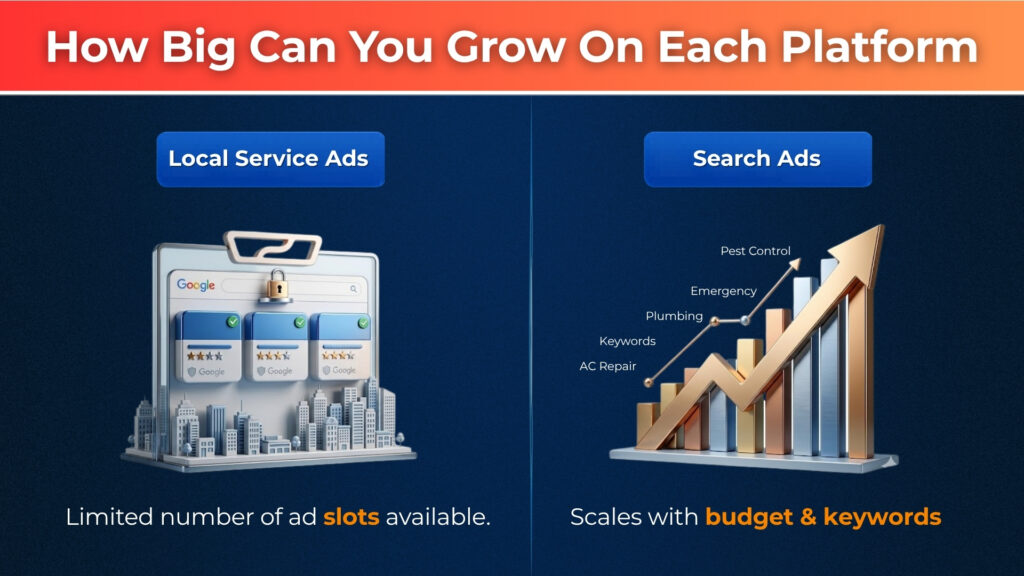
If you are in a big city with 50 competitors, you might find that your lead volume hits a ceiling.
This is where the debate of Google LSAs vs. Search Ads shifts in favor of the traditional search model.
Search ads have virtually no ceiling as long as you have the budget and the keyword list to support it. You can bid on thousands of search term variations to keep your calendar full.
This is why large, multi-truck operations rarely rely on LSAs alone to keep their teams busy. They use LSAs for the “easy wins” and search ads to capture the rest of the market share.
Fast Leads vs. Qualified Leads. Which One Actually Books More Jobs?
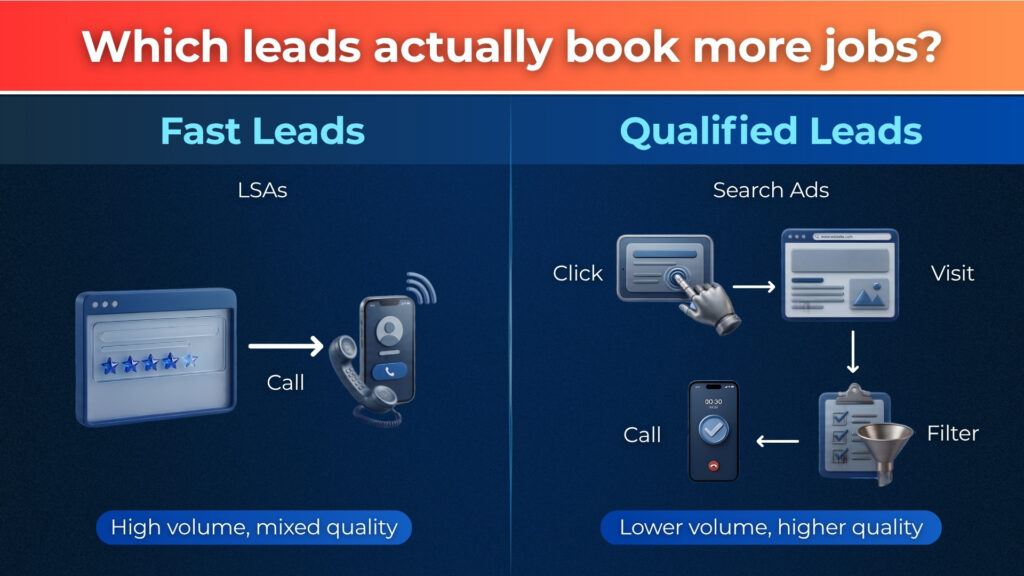
Not all leads have the same value, and this is where the difference between LSAs and Search Ads really matters. LSAs are built for speed. A customer sees your name, checks your rating, and taps “Call.” That’s it. There’s almost zero friction.
Search Ads, on the other hand, introduce a few extra steps:
- Click the ad
- Visit your website
- Read some content
- Decide whether to reach out
Every step creates friction, and every bit of friction reduces the number of people who contact you. But friction isn’t always a bad thing. If you’re getting a high volume of low-quality calls, that extra step can actually work in your favor.
A good landing page can:
- Pre-qualify the customer
- Set expectations (pricing, timelines, service area)
- Filter out people who aren’t serious
While LSAs may generate more calls, Search Ads often generate higher-quality calls. And better calls are usually what turn into booked jobs.
Stop Guessing & Start Booking Better Jobs.
Not every lead is worth your time, and not every platform is right for your business. Book a free strategy call and let’s map out the smartest way to grow your pipeline.
Why LSAs Struggle Outside Your Business Area
LSAs are powerful, but they come with a built-in limitation most businesses don’t realize until they try to grow. Google heavily prioritizes proximity, which means:
- The closer your business is to the searcher, the more likely you are to show up
- The farther away you are, the harder it gets to compete
- So if your office is on one side of the city, getting consistent leads from the other side can be a challenge.
This becomes a real issue when:
- You’re trying to expand into new neighborhoods
- You want to test a new service area
- You’re planning growth beyond your immediate location
Well, Search Ads don’t have this problem. You can:
- Target specific ZIP codes
- Expand into new areas instantly
- Test demand before committing to a new location
Why this matters for bookings:
- If LSAs limit where you appear, they also limit how many jobs you can win.
Search Ads give you control over where your next customer comes from.
Why LSAs Often Win on Mobile
Most searches today happen on a smartphone, where visibility is everything. LSAs dominate the top of the screen.
Before a user even sees organic results or the map pack, they see:
- Your business name
- Your reviews
- A big, easy “Call” button
No scrolling. No thinking. Just tap and call.
Search Ads can also drive calls, but they usually:
- Require an extra tap
- Feel more cluttered
- Compete for attention on a smaller screen
And, if you’re not in those top positions on mobile, you’re basically invisible. For industries where people need help fast (plumbing, HVAC, locksmith, etc.), this gives LSAs a major advantage.
The 2026 AI Factor: Beyond the Simple Search
If you’ve searched for anything recently, you’ve noticed that Google doesn’t just show links anymore; it provides an AI Overview that summarizes the best answer for you.
Many business owners worry that this AI Mode will hide their business. In reality, it has created a massive new opportunity for those who know how to play the game.
Here is how the two platforms have evolved:
Search Ads in the AI Era
Standard Search Ads are no longer just text at the top of the page. In 2026, your Search Ads are now integrated directly into Google’s AI Overviews.
- The Next Step Advantage: When a customer asks a complex question like, “How do I know if my 1950s electrical panel is safe?”, Google’s AI provides the answer and then features a Search Ad as the logical Next Step to book an inspection.
- Conversational Context: Because Search Ads use AI Max and broad intent matching, your business can show up in deep, conversational research phases that LSAs simply can’t reach.
LSAs in High-Intent Searches
LSAs play a critical role when users are ready to take action. In high-intent local searches, whether typed or spoken, Google often prioritizes verified, nearby businesses.
- Built for Immediate Action: When someone searches for or says, “find a plumber near me,” Google surfaces options that let the user call or message instantly. LSAs are designed specifically for this moment.
- Trust and Verification Signals: Because LSAs include Google-backed verification, reviews, and licensing checks, they provide a level of confidence that aligns well with urgent, decision-ready searches.
LSAs don’t replace Search Ads; they complement them. While Search Ads capture demand during the research and discovery phase, LSAs step in when users are ready to take action, helping businesses connect with high-intent customers ready to book.
Why You Should Use Both
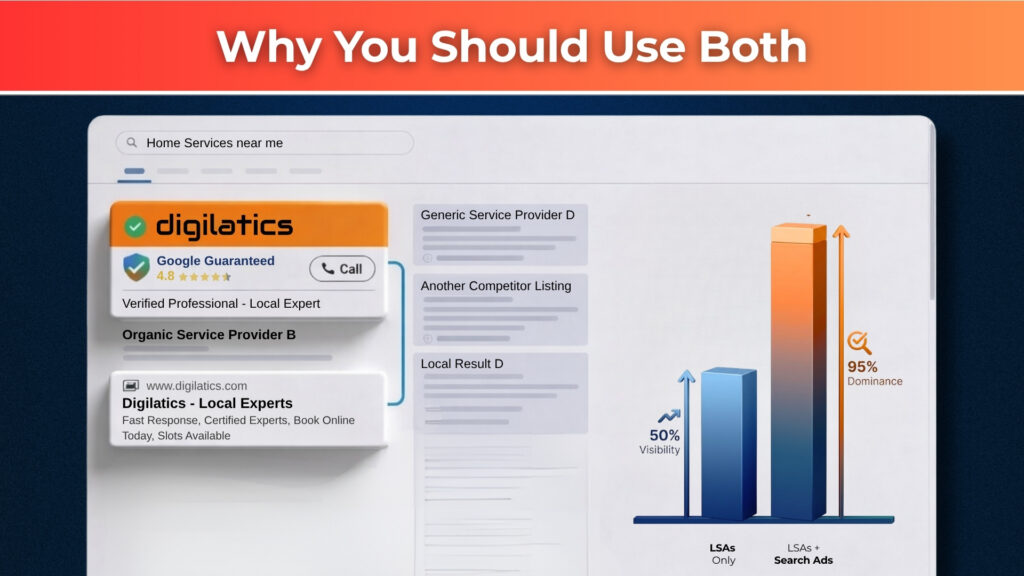
The most successful service-based companies we see do not choose just one.
They treat Google LSAs vs. Search Ads as a combined strategy to dominate the entire page. By running both, you can take up two of the top four spots on a Google search result.
This makes it twice as likely that a customer will click on you instead of your rival. It also gives you a safety net if Google’s algorithm decides to hide your LSA profile for a few days.
Search ads provide a consistent baseline you can always rely on, provided you are willing to pay.
Think of LSAs as your primary engine and search ads as your turbocharger.
One keeps you moving forward, while the other gives you the extra power when you need it most. This omnichannel approach is how you build a brand that people recognize and trust.
Scale Your Service Business with Digilatics
Online advertising can feel like a maze. You should not have to become a full‑time Google Ads manager just to keep your crews busy.
Digilatics focuses on one thing: helping service‑based businesses turn platforms like LSAs and Search Ads into reliable, measurable growth.
When we work together, we:
- Map your full path from search to revenue.
- Build the right mix of LSAs and Search Ads for your market.
- Track the numbers that actually matter: cost per booked job, payback period, and profitable scale.
If you are ready to stop guessing and start growing with a clear plan, we should talk.
Book a free growth strategy call and see what your lead generation could look like when both LSAs and Search Ads are working in your favor.